MagSafe Explained: The 20-Year Story Behind Apple’s Magnetic Snap
From a laptop cord that let go before it dragged your MacBook off the desk, to a cancelled charging mat, to a 25 W standard the whole industry now builds on. Here is how the magnets got there — and why alignment, not wattage, is the real story.
Carmountsupply · Wholesale Insights
Key takeaways
The twenty-year story of Apple's magnetic attachment — from the 2006 MacBook power cord and the cancelled AirPower mat to MagSafe on iPhone, Qi2 and the 25 W Qi2.2 era.
MagSafe began in 2006 as a breakaway MacBook power connector, not a charger.
AirPower failed in 2019 because overlapping coils overheated — alignment, not wattage, was the lesson.
iPhone MagSafe arrived on 13 October 2020 with a magnet ring, 15 W and an NFC loop.
Apple contributed the magnet geometry to Qi2 in 2023; Qi2.2 raised the open ceiling to 25 W.
'MagSafe compatible' without certification still means 7.5 W — the most expensive label trap in the category.
Newest iPhones reach 25 W (the iPhone Air caps at 20 W), and only with a 30 W+ adapter.
Keywords: MagSafe history · what is MagSafe · MagSafe explained · Qi2 vs MagSafe · why AirPower was cancelled · Qi2.2 25W
"MagSafe" is one of the most overworked words in consumer tech. It is a laptop power
port, a phone charging system, a wallet, a car mount, and — since 2023 — a piece of an open
industry standard that has nothing to do with an Apple trademark. Four different technologies have
carried the name in twenty years, and exactly one idea connects them: a magnet does the lining
up, so a connection either lands in the right place or lets go without breaking anything.
This is where that idea came from, why Apple killed it once, and why the version inside your phone
is now the reason every brand charges faster.
Twenty years of MagSafe in five acts. The 2017–2019 AirPower detour is what shaped
everything that came after it.
2006: the cord that lets go
On 10 January 2006 Apple announced the first MacBook Pro, and with it a power connector called
MagSafe. The problem it solved had nothing to do with power. Laptops were being destroyed by their own
cables: catch a foot on the cord and the machine came off the desk with it.
MagSafe held the plug on with magnets. A straight pull released it; a sideways yank — the kind
that happens when someone walks past a low table — popped it free before it could drag the laptop
with it. The idea is said to have come from the magnetic power cords on deep fryers and Japanese
countertop cookers, which exist for exactly the same reason: a hot appliance should not end up on the
floor because somebody tripped.
Two words, one principle: magnetic attachment (Mag) that fails safely (Safe).
Every later use of the name, including the one in your pocket, is a variation on that sentence.
MagSafe 2, and the years Apple dropped it
June 2012 brought MagSafe 2 — thinner and wider, to suit the slimmer Retina
MacBook Pro and the tapering MacBook Air. Then the industry's push toward one universal port arrived,
and Apple went along with it.
The 2015 MacBook charged over USB-C. The 2016 MacBook Pro followed. By 2019, when the last MacBook
Air with a MagSafe port left the line-up, the magnetic connector had disappeared from Apple's laptops
entirely — a rare case of Apple retiring one of its best-loved designs in favour of a standard
that everyone else used too.
It came back in October 2021 as MagSafe 3 on the 14- and 16-inch MacBook Pro, and
reached the M2 MacBook Air in June 2022. One detail says a lot about how Apple thinks about this
feature: the port returned to almost exactly the spot above the Escape key it had occupied fifteen
years earlier.
The detour that failed: AirPower
In 2017 Apple announced a different answer to cable clutter: AirPower, a mat that
charged an iPhone, AirPods and an Apple Watch at once, with the devices placed anywhere on the
surface. No magnets, no marked spots, no alignment.
It never shipped. Apple cancelled AirPower in early 2019, citing its inability to meet its own
standards — the physical cause being heat. A mat that lets you drop a device wherever you like
has to cover every possible misalignment at once, which means many overlapping coils, and overlapping
coils generating fields into each other produce heat that has nowhere to go.
The lesson Apple took from that failure is the key to everything that followed: coil
alignment is not a cosmetic nicety. It is the whole problem. So Apple stopped trying to make
misaligned charging work, and did the opposite — it made misalignment physically impossible.
13 October 2020: the name moves to the iPhone
At its "Hi, Speed" event, alongside the iPhone 12, Apple brought the MagSafe name back — this
time for a ring of magnets built into the back of the phone around the wireless charging coil. The
phone would snap to a matching charger or accessory in one exact position, at up to 15 W,
still working with ordinary Qi devices at up to 7.5 W.
Two things about that launch are easy to miss:
These were Apple's first chargers to use the Qi standard at all. The company that
had spent a decade on proprietary connectors had just adopted the industry's wireless standard —
the work that started with AirPower ended in a Qi-compliant magnetic puck.
There is an NFC loop in the same area. Magnets hold the accessory on; NFC lets the
phone recognise what attached, which is how a case, a wallet or a charger can behave
differently. The hardware is not just a magnet — it is a magnet plus an identity system.
Why alignment is the whole story
Wireless charging moves power between two flat coils through a magnetic field. The more those coils
overlap, the more of the field lands where it should. Slide the phone a few millimetres off-centre and
the coupling falls away — less power delivered, and a larger share of what is left converted into
heat inside the phone.
Why alignment decides everything. Same two coils in both panels — only the offset
changed.
Almost every MagSafe rule of thumb you have read follows from that one relationship:
What you notice
What is actually happening
A flat Qi pad charges an iPhone at 7.5 W while MagSafe reaches 15 or 25 W
The higher speeds are only certified when the charger can trust the coils are lined up
Charging slows down after twenty minutes
The phone is limiting power to control temperature, which is a protection, not a fault
A thick case makes charging crawl
Extra distance between the two coils weakens the coupling
A wallet or a metal plate stops charging entirely
Material in the gap absorbs or blocks the field
Put simply: magnets are not there to look clever. They buy the alignment that makes higher wattage
safe in the first place.
What is actually inside the back of a MagSafe iPhone
What sits under the back glass of a MagSafe iPhone. Simplified, not to scale.
Under the rear glass there are five cooperating parts:
A ring of magnets around the charging coil — the part that snaps. Apple has
used 100% recycled rare-earth elements in these magnets since the 2020 launch.
One alignment magnet, which sets the rotation so an accessory lands the same way
up every time.
The wireless charging coil, now sitting exactly where the charger's coil expects
it to be.
An NFC loop, so the phone can identify the accessory.
A magnetometer, so the phone can account for the extra magnetic field it is now
sitting inside.
None of it needs input from you. Bring the two close and the geometry does the rest.
2021 to 2022: the ecosystem fills in
With the mechanism proven, Apple spent two years expanding it. A MagSafe Battery Pack
arrived in July 2021. AirPods and AirPods Pro gained MagSafe charging cases in October 2021. MagSafe 3
returned to the MacBook Pro in the same month. And Apple began licensing the iPhone version to third
parties under its Made for MagSafe programme, which is where the word "certified" starts to
matter for buyers.
2023: the part that actually changed the industry
This is the turning point most people skip. In 2023 the Wireless Power Consortium
— the body behind the Qi standard used by virtually every wireless charger on earth —
announced Qi2, built on a Magnetic Power Profile that Apple contributed.
Read that again, because it is unusual: Apple handed its proprietary alignment trick to a standards
body, with no per-unit royalty attached. From that moment, any manufacturer could build a magnetic
charger that snaps to an iPhone and charges it at full speed, provided the product passed WPC
certification and carried the logo.
Why give it away? Because the alternative was fragmentation. A proprietary magnetic system only
grows as fast as Apple's licensing programme allows; an open standard grows as fast as Anker, Belkin,
Samsung, ESR, UGREEN and everyone else can ship. Apple keeps the trademark and the reference
implementation; the industry gets the geometry. That trade is why magnetic charging is now normal
rather than an Apple curiosity.
2024 to 2026: 25 W, and a handshake
With the standard open, the numbers moved quickly:
2024 — the second-generation MagSafe system arrived with the iPhone 16,
raising Apple's own ceiling to 25 W, provided the puck is fed by a 30 W-or-higher
USB-C adapter.
2025 — a revised MagSafe Charger was certified for Qi2 charging up to 25 W,
and Apple released a MagSafe Battery built specifically for the thinner iPhone Air.
2025, late summer onward — Qi2.2, marketed as "Qi2 25W",
raised the open standard's ceiling from 15 W to 25 W and added NFC-based accessory
identification, so charger and phone negotiate the highest safe speed instead of assuming
one. Early certified products carried roughly a 15–25% price premium over 15 W Qi2 hardware.
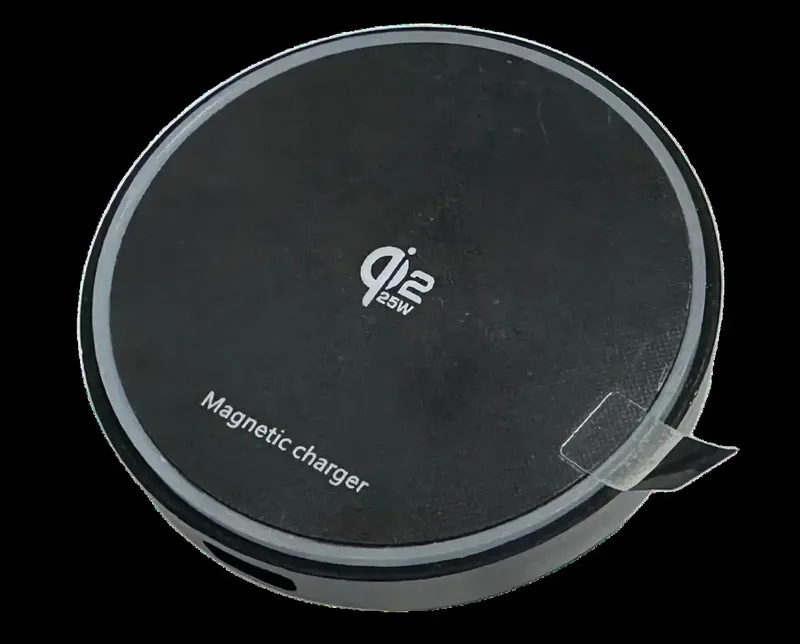
A current Qi2 25 W magnetic charging puck. The visible ring is the magnet array; the
printing is what the certification promises.
Where that leaves the current line-up:
Device
Magnetic charging ceiling
Needs a Qi2.2 / 25 W charger for maximum?
iPhone 17 / 17 Pro / 17 Pro Max
25 W
Yes
iPhone Air
20 W (thin chassis limits it)
Yes
iPhone 16 series
25 W over MagSafe; 15 W on older non-Apple Qi2 hardware
Yes, for the full 25 W
iPhone 15 series
15 W
No — original Qi2 or MagSafe is enough
iPhone 12, 13, 14
15 W (12 W on the 12 mini and 13 mini)
No
Android and older Qi phones
Up to 15 W where the model carries a magnet ring; 7.5 W or less otherwise
Varies by model
Note the shape of that table: from 2020 to 2026 the ceiling went from 15 W to 25 W, but the bigger
change is the third column. In 2020 speed depended on whether you bought Apple's charger. In 2026 it
depends on whether your charger and your phone can have a conversation.
The label trap: "MagSafe", "MagSafe compatible" and "Qi2"
Three different phrases get used interchangeably on product listings, and they mean three different
things.
Label
What it means
Typical iPhone charging speed
Made for MagSafe (MFM)
Apple-licensed hardware with Apple's certified module
Full speed for that iPhone generation (up to 25 W)
Qi2 / Qi2.2 certified
WPC-certified, same 44 mm magnet geometry, no Apple licence needed
15 W on Qi2; 25 W on Qi2.2 with a compatible iPhone
"MagSafe compatible" (uncertified)
Magnets only, no certification and no fast-charge module
Often 7.5 W — it snaps perfectly and charges slowly
That last row is the one that catches people. A product can attach beautifully, hold firmly, and
still be limited to 7.5 W. The word compatible is doing a great deal of work, and if a listing
claims 15 W while describing itself only as compatible, the certification is the question worth
asking.
Why some cases and wallets ruin the experience
A case with no magnet ring of its own. The magnets are in the phone, so the
accessory still attaches — but every extra millimetre weakens the pull, and the ring inside a
proper magnetic case reinforces it.
A very thick case. Distance hurts coupling, so charging slows before it stops.
Pre-MagSafe accessories. The old metal plates and adhesive rings designed for
plain magnetic holders can block the field entirely.
Magnetic-stripe cards. Apple warns that MagSafe accessories can damage or
demagnetise cards with a magnetic stripe if they are pressed together. Chip and contactless cards are
unaffected.
Implanted medical devices. Apple advises keeping MagSafe accessories at least
15 cm (6 inches) from a pacemaker or defibrillator, and at least 30 cm (12 inches) apart while
wirelessly charging.
Three myths worth clearing up
"The magnets damage the battery." They do not. The field is static and the cells
do not care about it. What shortens battery life is heat — which is exactly why the phone
throttles charging instead of fighting the temperature.
"Wireless is still far slower than a cable, so there is no point." That was fair
in 2020, when the first MagSafe puck was measured charging at roughly half the speed of a 20 W wired
charger. At 25 W the gap is small enough that convenience usually wins for a top-up.
"Any Qi charger behaves the same." Only if the wattage tier and the magnet
geometry match. Otherwise you get attachment without speed, which is the most common disappointment in
this category.
What this means if you are the one buying
The whole history comes down to one purchasing rule. Magnetic attachment is easy to copy; certified
power delivery is not. If a magnetic mount or charger claims a wattage, ask which certification backs
it, what the pull force measures, and whether the thermal design sustains a twenty-minute session
rather than surviving a thirty-second test.
That is the difference between an accessory that snaps and an accessory that sells twice.
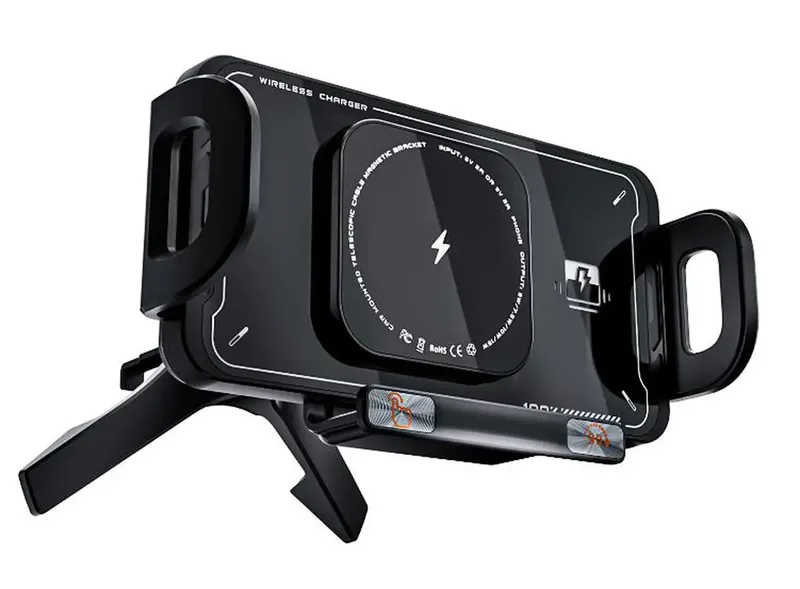
A thermoelectric-cooled magnetic car mount. Active cooling exists because wireless
charging always wastes some energy as heat — the exact problem alignment was invented to
reduce.
Apple. The name first appeared on 10 January 2006 as the magnetic power connector of the first MacBook Pro. The phone version that people mean today was announced on 13 October 2020 with the iPhone 12.
Is MagSafe the same thing as Qi2?
They are close relatives, not the same product. Apple contributed its magnetic alignment design to the Wireless Power Consortium, which folded it into Qi2 as the Magnetic Power Profile. MagSafe is Apple trademarked hardware for iPhone; Qi2 is the open standard any brand can build to after certification. Both use the same magnet ring geometry, so they attach to each other.
Why did Apple cancel AirPower?
Heat. The mat was designed to charge an iPhone, AirPods and an Apple Watch anywhere on its surface, which required many overlapping coils. Managing the heat and interference from that arrangement proved impractical, and Apple cancelled the product in early 2019. The lessons went straight into MagSafe.
How much faster is MagSafe than a normal wireless charger on iPhone?
On current iPhones the difference is roughly three-fold: an uncertified flat Qi pad is typically held to 7.5 W, while MagSafe and Qi2.2 reach 25 W on the iPhone 16 and 17 generations. Older iPhones cap at 15 W, and the iPhone Air at 20 W.
Does MagSafe work with Android phones?
The magnets will hold any phone that has a magnetic case or ring attached, and the charging works where the phone supports Qi2. The 25 W tier, however, is specific to iPhone hardware.
Does a MagSafe charger damage credit cards or medical devices?
Apple warns that MagSafe accessories can damage magnetic-stripe cards pressed against them, and advises keeping them at least 15 cm from an implanted pacemaker or defibrillator, or 30 cm while wirelessly charging. Contactless and chip cards are unaffected.
Why is my MagSafe mount charging so slowly?
Usually one of four things: a "MagSafe compatible" accessory that was never certified above 7.5 W, a thick or non-magnetic case adding distance between the coils, an underpowered adapter (25 W charging wants a 30 W-or-higher USB-C power supply), or simple heat throttling after a long session.
Should I stock Qi2 or Qi2.2 hardware?
Both, in stages. 15 W Qi2 remains the volume tier and is enough for iPhone 12 through 15. Qi2.2 ("Qi2 25W") is what iPhone 16 and 17 owners need to see the full speed, and it still commands a premium, so a small fast-moving assortment alongside the proven 15 W range is the lower-risk order.
Source these products direct from the factory
Get wholesale pricing, OEM/ODM options, and samples for any model on this page.