Key takeaways
No — properly shielded neodymium magnet arrays cannot damage a phone’s screen, battery, GPS or camera. The two genuine cautions are magnetic-stripe cards held against the magnet and misplaced metal plates. Sellers who can explain this close more orders.
- Modern mounts use shielded neodymium arrays: the field is deliberately routed inside the mount head, not into your phone.
- Phones themselves are full of magnets — speakers, haptics, the MagSafe ring — and are engineered to live with them.
- The real caution: magnetic-stripe cards (older hotel keys, some transit cards) should not sit directly on the magnet.
- A second fixable issue: a thick or badly placed metal plate can gap the wireless-charging coils — spec alignment, not fear.
Keywords: do magnetic car mounts damage phones · magsafe magnet safety · magnetic phone holder faq · magnetic mount vs credit card
Every seller of magnetic car mounts hears the same question, in every market:
“Won’t the magnet damage my phone?” It is a reasonable question from a customer
who remembers floppy disks dying next to magnets in the 1990s. It is also the objection that
kills more magnetic-mount sales than any price gap — and the easiest one to answer with
confidence, because the physics is firmly on your side. This guide gives wholesale buyers the
full picture: what magnets can and cannot affect, the two cautions that are real, and
ready-to-use answers your sales channels can copy verbatim.
The short answer, and the physics behind it
Modern magnetic car mounts do not damage phones. The magnet array in a quality mount uses
neodymium (NdFeB) magnets arranged in a paired or ring configuration with a steel backing plate.
That arrangement does two things: it concentrates the holding field outward toward the
phone’s MagSafe ring or supplied plate, and it shunts the stray field back through the
steel instead of radiating it into the phone body.
The numbers make the point better than adjectives. A typical shielded mount head produces a
surface holding force of 800–1,500 grams, but the stray field at the phone’s back glass is a
small fraction of that, and it falls off with the square of distance — doubling the gap cuts the
field to a quarter. Phone makers assume this environment exists: the phone itself contains
dozens of magnets (speakers, vibration motor, camera OIS actuators, the MagSafe ring in every
iPhone since the 12 series) and is engineered to operate in their presence.
For context on how the ecosystem normalized magnet-on-phone, our
MagSafe accessory guide covers how Apple built an entire magnetic standard around the back
of its phones.
What a mount magnet can and cannot affect
| Concern | Reality | Why |
|---|
| Screen / OLED panel | No effect | OLED and LCD panels are not magnetically sensitive devices |
| Battery / charging | No effect | Static fields do not alter lithium chemistry or charging circuits |
| GPS accuracy | No effect | GPS works on satellite radio signals, not magnetism |
| Camera / photos | No effect | Sensors and lenses contain no magnetically written data; OIS actuators use their own magnets |
| Compass app | Temporary, self-correcting | The magnetometer reads any nearby field; phones recalibrate automatically |
| Wireless charging | Only if a plate misaligns the coils | Magnet ring is placed around the Qi coil, not across it — a spec point to verify |
| Magnetic-stripe cards | The one real caution | Stripes write data magnetically; direct, prolonged contact with the bare magnet can degrade it |
| Chip (EMV) / NFC bank cards | No effect | Chip and NFC transactions are not magnetically stored |
The two cautions that are actually real
Honest answering builds more trust than blanket reassurance. There are exactly two genuine
cautions, and both are easy for a seller to state and defuse:
- Magnetic-stripe cards against the bare magnet. Older hotel key cards, some
transit cards and legacy gift cards store data on a magnetic stripe. Pressed directly against
the mount’s magnet — for instance wedged between phone and mount head — a stripe can weaken over
time. The practical advice: keep cards in a wallet. Chip cards and NFC payments are immune.
- Third-party metal plates over the charging coil. For non-MagSafe phones,
mounts ship with a metal plate that sticks to the phone or case. If the plate is placed over the
wireless-charging coil area (center-back on most phones), it can gap the coils and slow or stop
charging. Quality mounts mark the correct plate position in the instructions — check that the
instruction sheet exists before you approve a sample; it is a one-page spec item that prevents
a whole returns category.
Neither caution involves damage to the phone itself — which is precisely the framing that
reassures end customers: the device is never at risk; two everyday habits avoid the only
inconveniences that exist.
Ready-made answers for your sales channels
Whether you sell on Amazon, run retail counters or supply corporate fleets, your channel
partners need scripted answers. These four cover most conversations:
| Customer says… | Seller answer |
|---|
| “Magnets will ruin my phone’s battery.” | “Phones already contain dozens of magnets — the speakers, the vibration motor, and on iPhones the entire MagSafe ring. Your battery is sealed in its own shielded compartment and static magnets don’t affect lithium chemistry.” |
| “Will it wipe my cards?” | “Chip and contactless cards aren’t magnetic. For old stripe cards, keep them in your wallet rather than between the phone and the mount — same advice every bank gives.” |
| “My GPS will go crazy.” | “GPS uses satellites, not magnetism. The compass sensor recalibrates itself in seconds — that’s built into every phone.” |
| “Will charging still work on the mount?” | “Yes — the magnet ring sits around the charging coil, so it centers the phone for better alignment. On non-MagSafe phones, the plate goes above the coil; the instructions mark the spot.” |
Sellers who answer with specifics convert the objection into the strongest trust moment in
the whole sale. Distributors can reproduce these lines in listing copy and packaging inserts —
a low-cost way to cut pre-purchase questions and returns at the same time.
Spec-sheet checks before you place a bulk order
“Magnetic safety” is not only a marketing conversation — it is a QC item. When sampling
magnetic mounts, ask the factory for:
- Holding force in grams on the phone-side surface (not marketing adjectives).
For 6.7-inch phones, look for roughly 800 g or better with a plate, and verify on a rough-road
test with a thick case.
- Shielding construction: paired magnets or a ring with steel backing, not a
single bare magnet. Ask how the array is oriented.
- Coil geometry on wireless-charging models: magnet ring concentric with the
Qi coil, and the coil spec (5W/15W/25W) stated honestly — our
MagSafe vs Qi2 guide explains what those numbers mean.
- Plate placement guidance in the box, plus a foam spacer where the mount
touches the phone back.
- Sample behavior check: compass app opens, phone charges on the mount,
no interference on a call. Ten minutes of testing covers every customer fear.
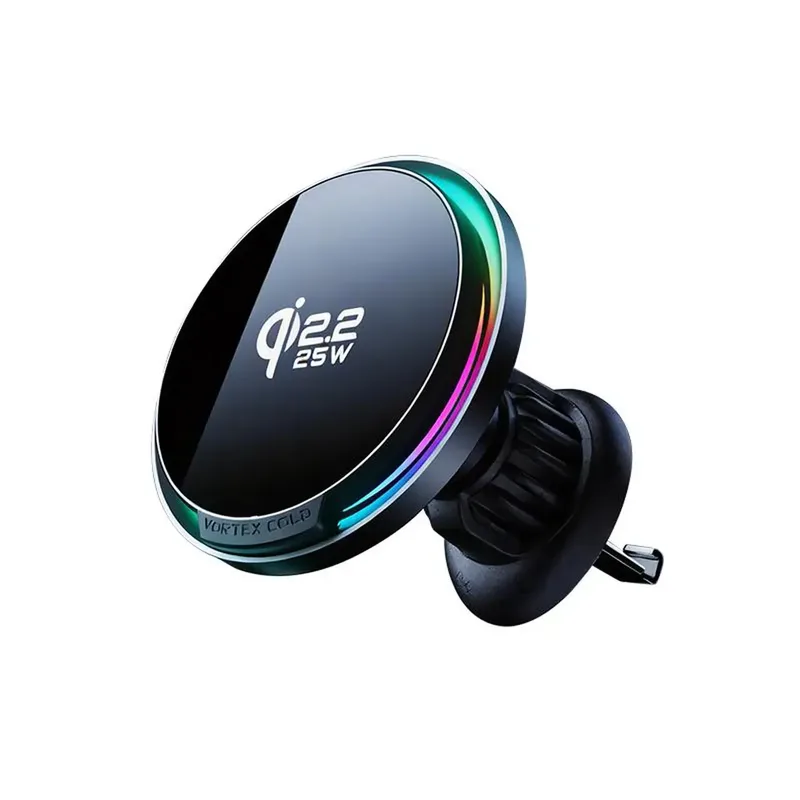
Our own magnetic line — 78 factory models from passive vent mounts to 25W magnetic wireless
chargers — is listed on the magnetic car phone holder wholesale
page, and every model ships with the shielding and alignment specs above on request.
Turning the objection into a selling point
The objection is actually a positioning gift. A mount that has to explain itself is a
mount the customer is already imagining owning. Practical angles that work in listings and
retail scripts:
- “Engineered like MagSafe” — reference the standard customers already trust.
- “Holds 1 kg, protects everything” — pair holding-force numbers with the
safety message in one line.
- Include a mini-FAQ card in retail packaging — pre-empts the question at the
moment of doubt, and cuts returns driven by buyer’s remorse.
- B2B tenders: put the shielding spec and the card-caution note in your offer
documents. Fleet buyers read it as supplier maturity — exactly the impression an OEM/ODM
partner should make; see our OEM/ODM program.
With MOQs of 50–100 pcs per model and samples in 3–5 days, adding a well-specified magnetic
line to your assortment is a low-risk experiment — and now you can answer the one question your
customers will certainly ask.
Get a free sample / wholesale quote: tell us your target market and monthly
volume on the wholesale inquiry page — a tailored price list with
full magnetic specs comes back within 24 hours.
More wholesale guides: Magnetic vs clamp vs suction mounts · Magnetic vs vent mounts · The history of MagSafe.
FAQ
Are MagSafe magnets bad for your phone battery?
No. Lithium batteries are not affected by static magnetic fields at the strengths used in car mounts. Apple’s own MagSafe ecosystem embeds magnets in every iPhone since the 12 series, and battery health, charging circuits and the battery management system are all shielded against exactly this concern.
Do magnetic mounts affect wireless charging?
A correctly designed mount does the opposite — it centers the phone so the coils align. Problems only appear when a third-party metal plate is sandwiched between the phone and the charger or placed over the coil area. Quality mounts position the magnet ring around the charging coil, not across it.
Can a magnetic car mount erase my credit card?
Only if a magnetic-stripe card is pressed directly against the bare magnet and left there. The field at the phone-side surface of a shielded mount is far weaker than at the magnet core. Keep striped cards in a wallet or a pocket rather than wedged between phone and mount, and chip-based cards (EMV) and NFC bank cards are not affected at all.
Are magnetic mounts safe for the camera or GPS?
Yes. GPS reception depends on satellite signals, not magnetism, and camera sensors are not magnetic devices. The magnetic compass is the one sensor that can read a nearby magnet — and phones handle it by recalibrating with a figure-eight motion whenever the reading looks implausible. Navigation apps re-acquire heading within seconds.
How long does production take?
7–15 working days after deposit for regular orders. Samples ship in 3–5 days, and custom OEM packaging adds roughly a week.
Can I put my own brand on the product?
Yes. We provide logo printing, custom colour, retail gift box, manual and barcode, and private mould development from about 10,000 pcs.
Which certificates do you provide?
CE, RoHS and FCC for the electronics, plus UN38.3 and MSDS when a lithium cell is included. Originals are available for customs clearance.
Source these products direct from the factory
Get wholesale pricing, OEM/ODM options, and samples for any model on this page.
Get Wholesale Quote →