
HUAWEI Mate XT 2 Ultimate Design: The Tri-Fold Goes Inward — Full Review
HUAWEI reinvents its tri-fold flagship with a wing-like inward-folding design, a 10.2-inch 3K main screen, the in-house Kirin 9050 Pro, and a 5,600mAh battery. Here is the complete spec breakdown, China pricing, and what it means for accessory buyers.
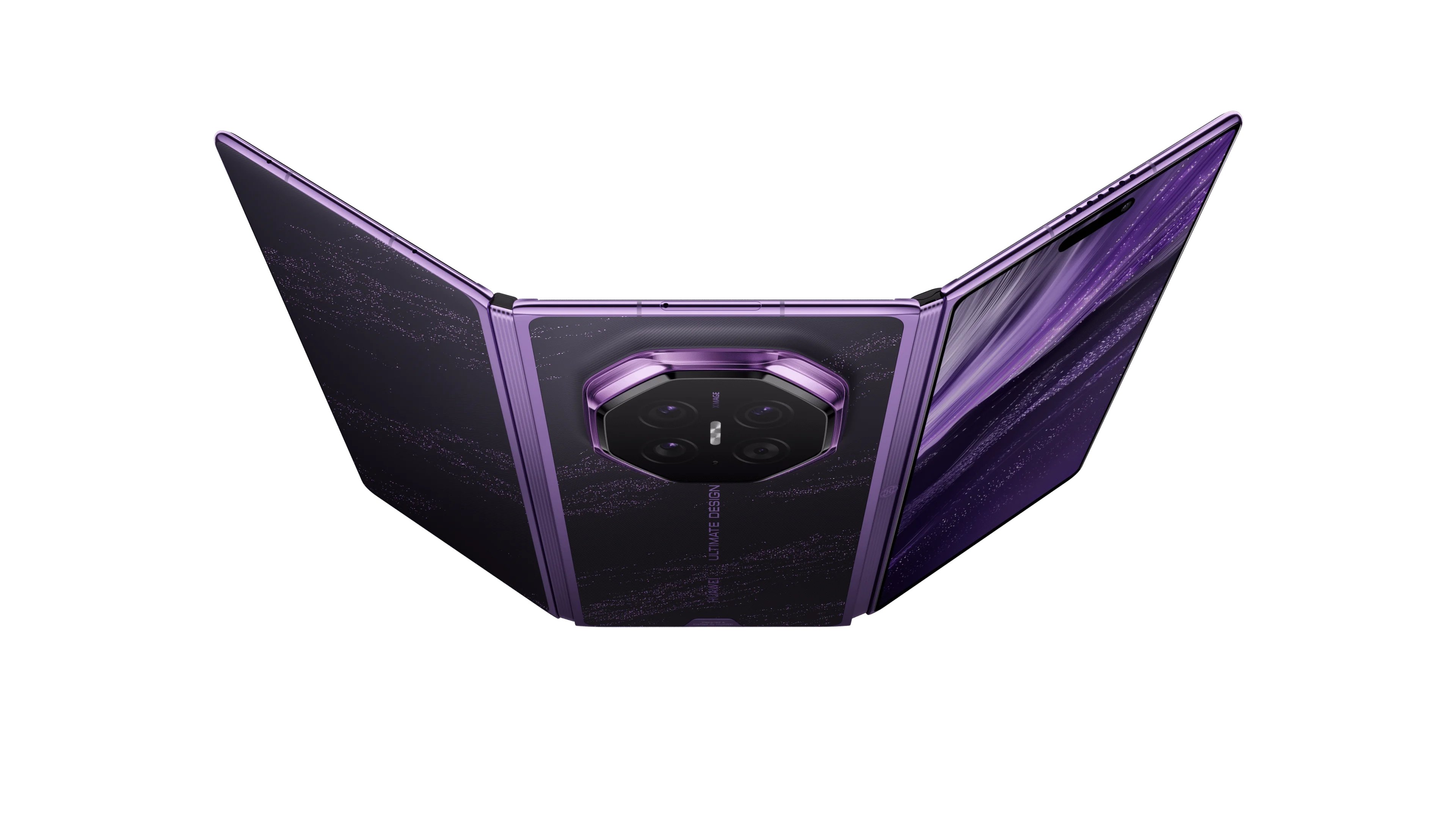
For two years, the tri-fold phone was a curiosity that only one company dared to mass-produce. The original HUAWEI Mate XT proved that a phone could unfold from a single screen into a tablet-sized panel by bending in two places — but it wrapped its flexible display around the outside, leaving the most fragile part of the device exposed whenever it was closed. With the Mate XT 2 Ultimate Design, HUAWEI has answered that single biggest criticism. The new model folds both halves inward, like a pair of wings closing over the screen, so the 10.2-inch panel is protected the moment the phone shuts. It is a deceptively simple change that reorders the entire engineering story: hinge, glass, battery, and cooling all had to be rethought to make an inward tri-fold that is thinner, lighter, and more durable than the phone it replaces.
This is not a minor refresh dressed up with a new name. HUAWEI calls the new geometry a "wing-like tri-fold" (展翼三折叠), and the numbers tell the tale. The device launches with the Kirin 9050 Pro — the most powerful mobile chip HUAWEI has ever shipped — paired with a dedicated LogicFolding Tau co-processor that manages the three-panel mechanism. The main screen is a 10.2-inch LTPO OLED at 3K resolution, the cover screen is a 6.5-inch panel that finally feels like a real phone when the device is closed, and the whole thing weighs 299 grams while carrying an IP58/IP59 rating that is almost unheard of on a foldable. For anyone who looked at the first Mate XT and thought "brilliant idea, wrong fold," the Mate XT 2 is the device that may finally close the argument.
For wholesalers and accessory sellers in the car-mount and wireless-charger space, the Mate XT 2 also matters because it redefines what "foldable compatibility" means. A tri-fold is three times the engineering challenge of a book-style fold: it has three screen states, two hinge axes, and a footprint that changes dramatically between closed and fully open. A cradle that grips a normal slab phone will not survive contact with a 12.3-millimeter-thick closed tri-fold, and a mount designed for a book-style foldable will not hold a 10.2-inch tablet-sized panel in landscape. In this article we break down every major specification, compare the Mate XT 2 to its rivals, and explain why the new inward fold makes a purpose-built car mount more important than ever.
Design & Build: The Wing-Like Tri-Fold
The headline change is the fold itself. The original Mate XT folded outward, wrapping its screen around the exterior so that the flexible panel was the outermost surface whenever the phone was closed. That made the device vulnerable to scratches and pressure, and it demanded constant care. The Mate XT 2 flips the philosophy: both outer panels now fold inward, closing like the wings of a bird, with the 10.2-inch display tucked safely inside. The result is a device that behaves like a normal phone when closed and reveals its full canvas only when you choose to open it — the way a foldable probably should have worked from the start.
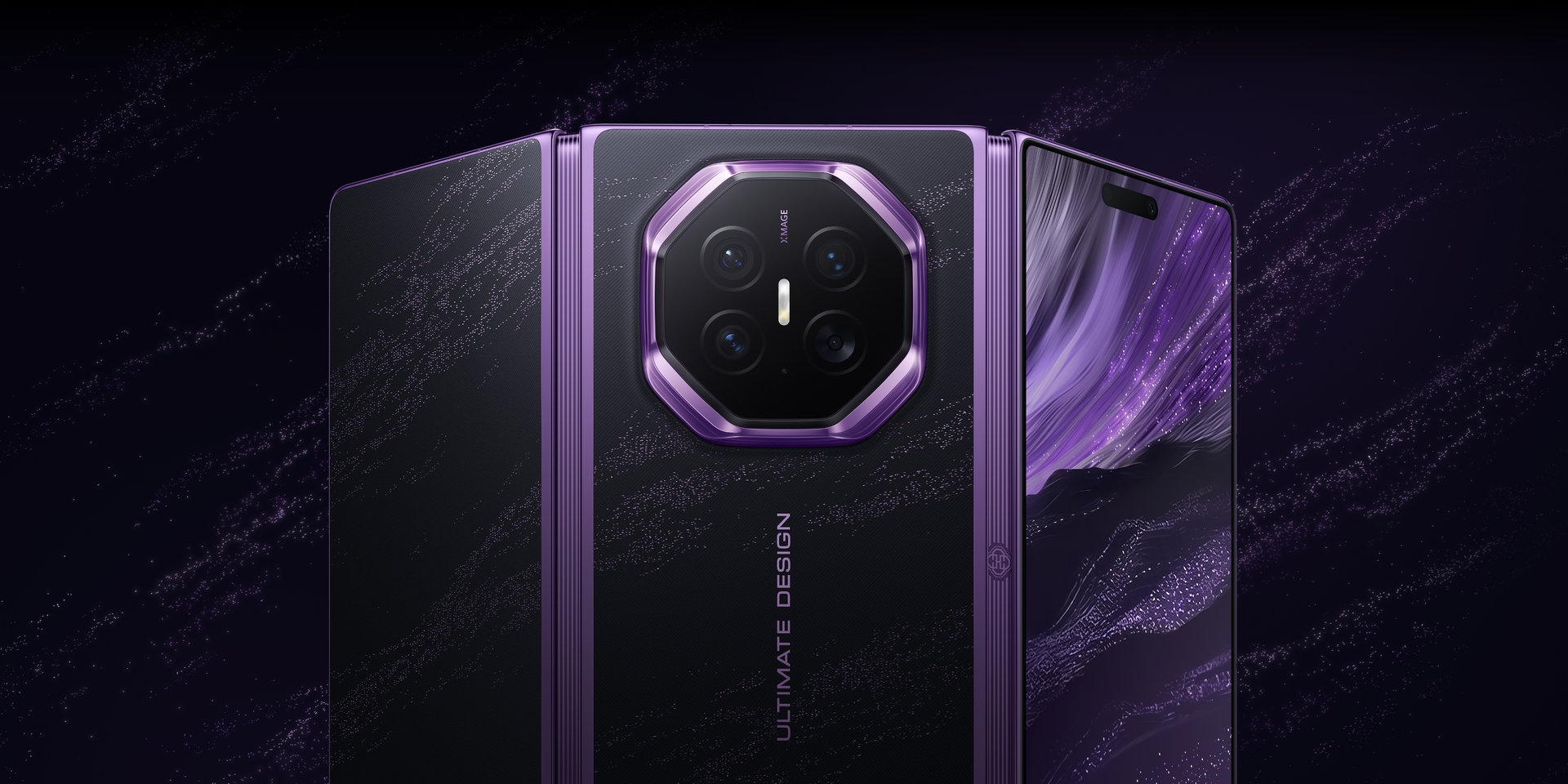
HUAWEI describes the structure as the "Tri-Fold Basalt Architecture" (三折叠玄武架构), a layered system of protection borrowed conceptually from the basalt rock formations the company uses as a durability metaphor. The cover screen is protected by Xuanwu Kunlun Glass (玄武昆仑玻璃), a material HUAWEI says improves both drop resistance and scratch resistance while adding an anti-glare, low-reflection surface so the display stays readable under bright light. The inner screen is a different beast: a super-thin UTG (ultra-thin glass) layer bonded over an aerospace-grade high-strength steel buffer layer and a carbon-fiber support structure, giving the panel the rigidity to lie flat when open yet the flexibility to survive hundreds of thousands of folds.
The hinge is the second-generation Tianguan (天工) system, and HUAWEI claims several industry firsts for it. It uses a link-synchronous mechanism with a gearless, dual-track design that opens and closes smoothly while distributing force evenly across the five-arc main shaft. HUAWEI says the new hinge improves impact resistance by 90 percent over the previous generation, which is the kind of claim that only real-world wear will fully confirm, but the design intent is clear: make the mechanism the strongest part of the phone rather than the weakest. When closed, the Mate XT 2 measures 157.2 by 77 by 12.3 millimeters and weighs 299 grams — heavy by slab-phone standards, but reasonable for a device that unfolds into a 10.2-inch tablet.
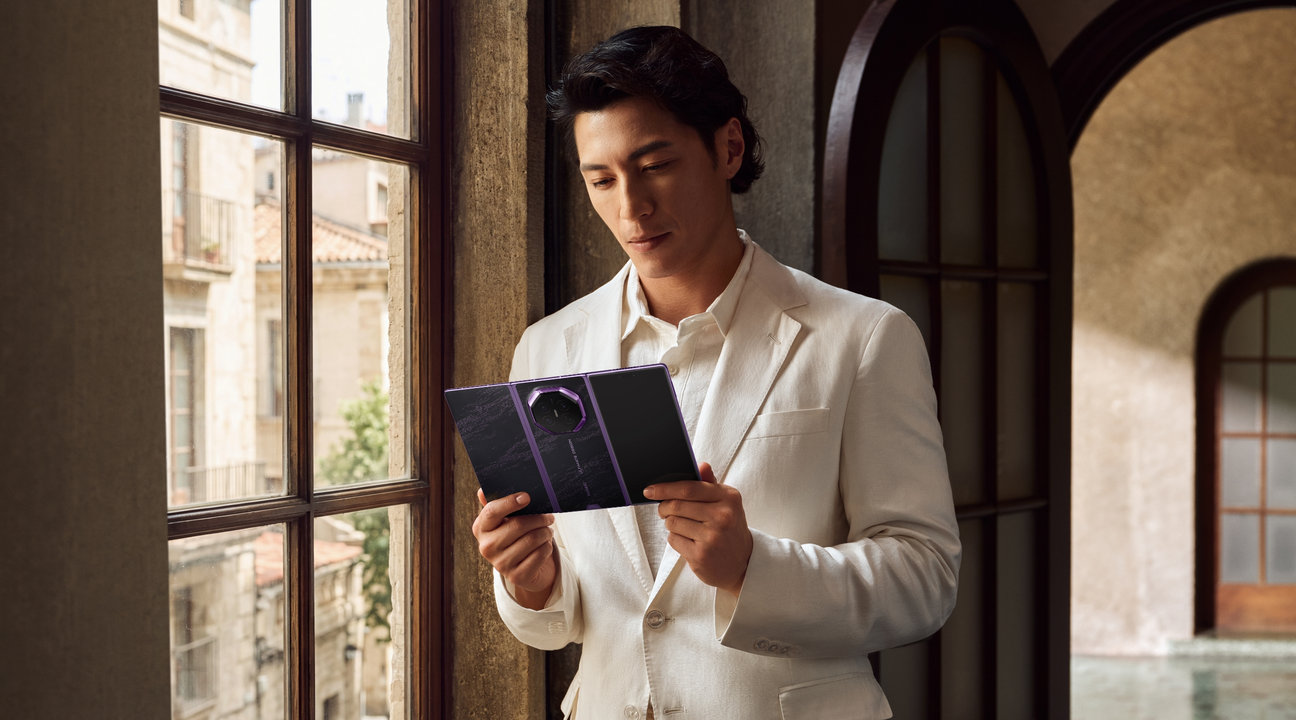
HUAWEI leans hard into the "Ultimate Design" part of the name. The rear panel uses a star-diamond (星钻) finish built from yttrium-crystal glass (钇晶宝石) polished through eight processes and cut with 33 facets so light plays across the surface. A separate "Cloud Brocade" (织金云锦) pattern evokes traditional Chinese textile craft, and the "Master" insignia of the Ultimate Design line is engraved into the corner. Three colors launch at release: Dark Black (玄黑), Pure White (皓白), and Brocade Purple (锦紫). Each keeps an understated, jewelry-like aesthetic that reads as premium without being loud — the kind of device that photographs well on a boardroom table.
Displays: Three States, One 10.2-inch Canvas
The most important change on the Mate XT 2 is not any single number but the relationship between its three display states. When fully closed, you get a 6.5-inch LTPO OLED cover screen with a 120Hz refresh rate and Xuanwu Kunlun Glass on top — a genuinely usable phone, not a cramped strip. Unfold one panel and you reach an intermediate dual-screen state suited to quick reading or split tasks. Unfold both and the device becomes a 10.2-inch LTPO OLED at 3184 by 2232 pixels (a 3K-class resolution, roughly 381 pixels per inch), the largest flexible panel on any phone you can buy in 2026.
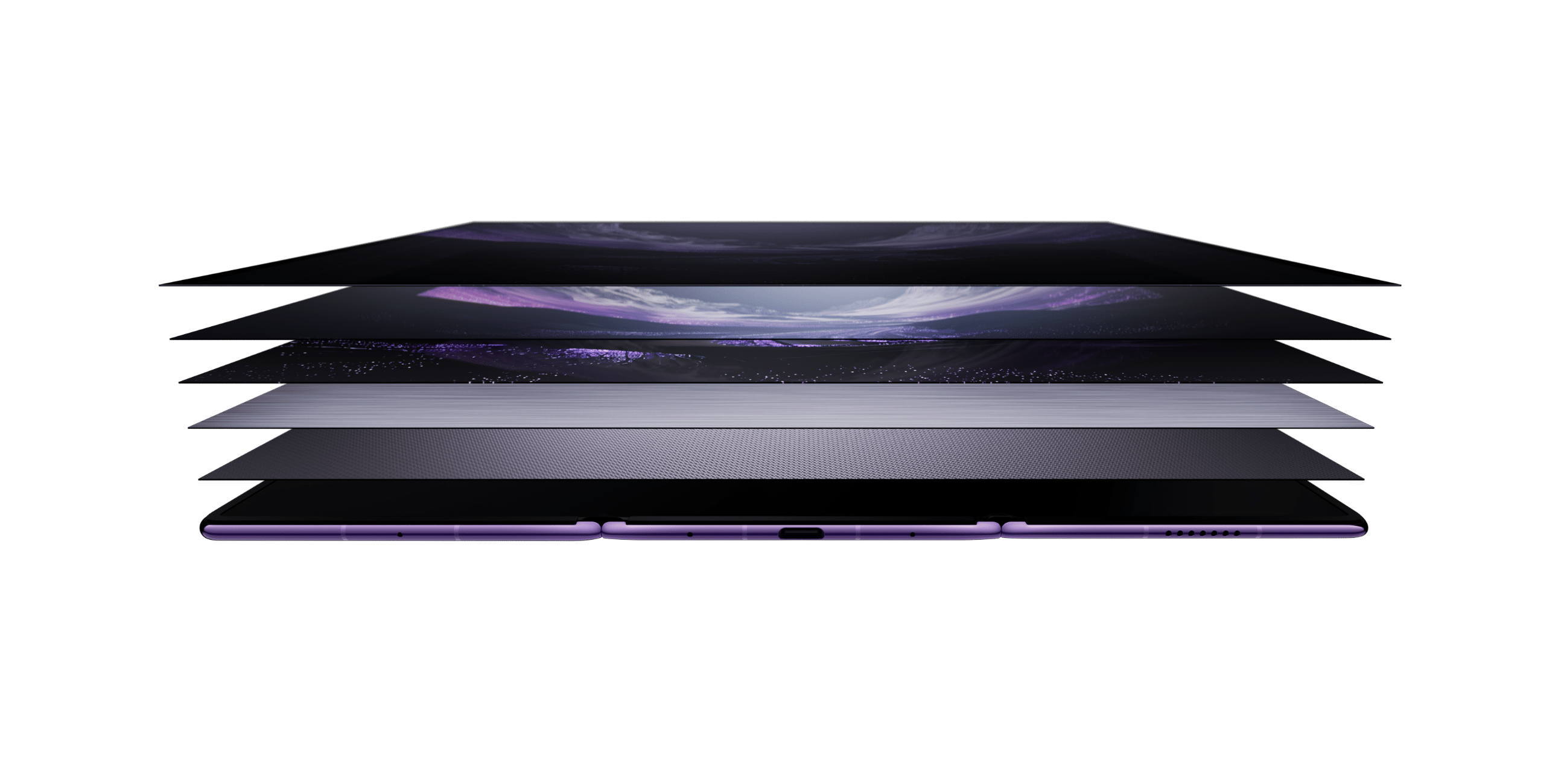
The main panel uses an adaptive LTPO backplane that can scale from a low idle rate up to 120Hz for smooth scrolling and gaming, and it employs 1440Hz high-frequency PWM dimming to reduce flicker at low brightness — a meaningful comfort feature for users who read at night. HUAWEI pairs the big panel with a "Lingdun" (灵盾, "Spirit Shield") privacy screen option on the 1TB configuration: a hardware-level solution that uses an independent dual-pixel design so that when privacy mode is on, side viewing angles are sharply reduced while the front-facing resolution stays identical. In practice this means you can review sensitive documents on a train without the person beside you seeing the contents, and the screen does not lose sharpness the way software-based privacy filters usually do.
Because the Mate XT 2 is a true tri-fold, the software has to treat the screen as three regions. HUAWEI's HarmonyOS 7 is built for exactly this: it lets the device behave as a phone, a booklet, or a tablet depending on how many panels are open, and it reflows apps and the on-screen keyboard accordingly. The 10.2-inch canvas is large enough for side-by-side documents, a spreadsheet with a reference pane, or a video call with shared notes — use cases that book-style foldables handle only awkwardly because their inner screens are narrower. For road warriors who want one device to replace both a phone and a small tablet, the Mate XT 2 is the most convincing argument yet.
Performance: Kirin 9050 Pro + LogicFolding Tau
Powering the Mate XT 2 is the Kirin 9050 Pro, HUAWEI's newest in-house flagship processor built on domestic silicon independent of U.S. supply chains. HUAWEI states the chip delivers roughly a 42 to 46 percent overall performance gain over the previous Kirin 9030 Pro, with improvements spread across CPU, GPU, and the NPU that handles on-device AI. Paired with it is a first for the line: the LogicFolding Tau ( logic folding) co-processor, a dedicated chip that manages the tri-fold mechanism — sensing open angle, coordinating the two hinge axes, and offloading that work from the main SoC so the phone stays responsive through thousands of folds.
Thermal design is where thin foldables usually compromise, and HUAWEI spends real effort here. The Mate XT 2 uses a distributed three-frame heat-source layout that separates hot components, combined with an extra-large VC vapor chamber and high-conductivity graphene sheets to move heat away from the chip quickly. The payoff is sustained performance: HUAWEI claims support for 50-million-pixel real-time ray-tracing hardware acceleration for gaming, stable high frame rates in demanding titles, and smooth multi-task handling thanks to on-device large models. In plain terms, the phone is engineered to avoid the thermal throttling that plagues many slim flagships.
Connectivity is another focus. HUAWEI touts "5A" speed — fast, stable data across challenging environments — and demonstrates it with concert-venue uploads and smooth high-speed-train video calls. The device also supports Tiantong (天通) satellite communication and BeiDou (北斗) satellite messaging, so it can still reach the outside world where there is no ground network. For field workers, journalists, or anyone who travels far from coverage, that satellite fallback is a genuine safety feature, not a marketing line. RAM is fixed at 16GB across the range, with storage scaling from 256GB to a generous 2TB on the Collector Edition.
Cameras: Third-Generation Maple (Red Maple) Imaging
Photography is a headline strength of the Mate XT 2, and it centers on HUAWEI's third-generation Maple (红枫, "Red Maple") true-color camera system. The rear array sits in an octagonal module and combines a 50-megapixel main sensor with a 1/1.28-inch optical format, a variable aperture spanning f/1.5 to f/4.0, optical image stabilization, and an RYYB color filter with LOFIC technology for high dynamic range. Alongside it are a 50-megapixel periscope telephoto with 3.5x optical zoom and OIS, and a 40-megapixel ultra-wide camera — both also using the RYYB arrangement that HUAWEI favors for low-light sensitivity.
What distinguishes the Maple system is color fidelity. HUAWEI adds a multi-spectral channel true-color sensor that captures light information beyond the normal red-green-blue range, filtering out infrared interference so that whites and skin tones render accurately under mixed lighting. The 10th-generation ISP performs real-time skin-tone zone calibration, and the XMAGE soft-light effect can soften portraits for a flattering, film-like look. HUAWEI claims an 18 EV high dynamic range with a continuous variable aperture, so bright skies and dark shadows coexist in a single frame without blown highlights or crushed shadows — a feature that matters as much for product photography as for travel shots.
For selfies and video calls, HUAWEI places an 8-megapixel camera on the cover screen and another 8-megapixel camera on the inner screen, so whichever folding state you are in, there is a front camera ready. Shooting modes lean into computational photography: an XMAGE smart-shoot mode with AI pose suggestions and AI-assisted framing, a "calendar mode" (台历模式) that frees your hands for creative angles, and macro, night, and fireworks modes that show off the system's dynamic range. The camera hardware is notably ambitious for a device this thin, and the periscope telephoto surviving the tri-fold packaging is itself an engineering win.
HarmonyOS 7 & the Big-Screen Experience
The Mate XT 2 is the launch device for HarmonyOS 7, and the software is clearly tuned for the tri-fold form. The headline productivity feature is three-window parallel multitasking: you can run three apps at once, each with independent volume control, and save window combinations for instant recall. On the 10.2-inch canvas this finally feels like a real desktop substitute — a stock-ticker widget with live market data, a document, and a messaging pane can all sit side by side without feeling cramped.
Beyond multitasking, HarmonyOS 7 adds big-screen annotation (record your screen while drawing on it, then share a marked-up clip in one step), big-screen gaming with a fully visible board, and creative tools like the GoPaint (天生会画) app and AI Inspiration Studio (AI 灵感妙创) for generating ideas and visuals. Celia (小艺), HUAWEI's assistant, can interpret ECG data and surface context-aware suggestions. The through-line is that the software treats the Mate XT 2 as a small computer that happens to fold, rather than a phone with a bonus screen — which is exactly the mindset a tri-fold demands.
Battery & Charging: 5,600mAh, 66W Wired + 50W Wireless
Despite the thin, three-panel body, HUAWEI fits a 5,600mAh battery using a silicon-anode architecture that is only 1.9 millimeters thick. That is a large cell for any flagship, let alone a foldable, and it underpins HUAWEI's all-day endurance claims. Wired charging runs at 66W, wireless at 50W, and the phone also supports 7.5W reverse wireless and 5W reverse wired charging so it can top up earbuds or a watch in a pinch. The combination of a big battery and fast wireless charging is well matched to a device that spends much of its life open and flat on a desk or dashboard.
Real-world endurance will vary with how often you use the full 10.2-inch panel, since a larger, brighter screen draws more power than the cover display. But the silicon-anode cell and efficient Kirin 9050 Pro pairing should comfortably carry a mixed day of messaging, navigation, camera use, and video. For accessory sellers, the 50W wireless figure is the headline: customers will expect a car mount that can deliver meaningful wireless power to a 5,600mAh cell without overheating, which raises the bar for any Qi2-class or HUAWEI-compatible charging cradle.
Durability: Xuanwu Kunlun Glass, G-Hinge, IP58/IP59
Durability is where foldables live or die, and the Mate XT 2 makes a credible case. The cover screen's Xuanwu Kunlun Glass resists scratches and drops while cutting reflections, and the inner UTG stack is reinforced with aerospace steel and carbon fiber. HUAWEI says the inner screen's impact resistance improves 200 percent and the hinge's impact resistance improves 90 percent over the prior generation. Most unusually for any foldable, the Mate XT 2 carries an IP58/IP59 rating — protection against dust ingress and against water jets and immersion — a level of ingress protection that book-style foldables rarely achieve because of the moving hinge.
HUAWEI is careful to frame this as everyday resilience rather than ruggedness: it is not a diving phone, and the rating covers specific test conditions. But an IP58/IP59 tri-fold is a meaningful step toward normalizing foldables as daily drivers rather than fragile showpieces. The inward fold helps too, because the most delicate surface is now protected the instant the phone closes, reducing the day-to-day risk of keys, coins, or a hard surface scratching the panel.
Unique Features: Privacy, ECG, and Satellite Comms
Three features separate the Mate XT 2 from nearly every rival. First, the Lingdun privacy screen (on the 1TB model) restricts side viewing at the hardware level while keeping full resolution on axis. Second, the device can perform ECG (electrocardiogram) analysis: unfold the screen, hold the two side bezels, and within 30 seconds it captures a signal that, paired with the heart-rate analysis app, generates an ECG report and can flag adult sinus rhythm, atrial fibrillation, and premature beats. HUAWEI stresses this is not a medical device and the interpretation is for reference only, but it is a thoughtful wellness addition.
Third, the satellite communication suite — Tiantong calls and BeiDou messaging — keeps the phone reachable where cellular coverage disappears. Combined with the distributed antenna system that HUAWEI says delivers "5A" speeds in crowded or high-speed environments, the Mate XT 2 is positioned as a device for people who cannot afford to be unreachable. These are the kinds of features that justify the "Ultimate Design" premium for a specific, well-heeled buyer rather than the mass market.
Pricing, Availability & Configurations
HUAWEI launched the Mate XT 2 Ultimate Design in China, with the launch event held in Guangzhou and sales opening shortly afterward. Pricing is structured around the 16GB RAM tier with four storage steps:
- 16GB + 256GB — ¥19,999 (approximately $2,800)
- 16GB + 512GB — ¥21,999
- 16GB + 1TB — ¥23,999
- 16GB + 1TB (with Lingdun privacy screen) — ¥24,999
- 16GB + 2TB Collector Edition — ¥29,999
At ¥19,999 to start, the Mate XT 2 sits firmly in ultra-premium territory, roughly comparable to the top tier of conventional foldables but offering a screen no book-style phone can match. HUAWEI bundles some configurations with the M-Pen 3 Mini stylus set, and a range of first-party accessories is available: a rotating-stand PU case, a stylus-charging case, and the M-Pen 3 Mini itself (sold separately). For accessory sellers, the clear opportunity is in cases and mounts engineered for the tri-fold's unusual closed thickness and open footprint.
For the car-mount channel specifically, the Mate XT 2 creates a clean opening. Because the device is 12.3 millimeters thick when closed — far thicker than a 8 to 9 millimeter slab — many universal cradles will not close around it or will press on the hinge. A wide-body cradle with deep side arms and a robust bottom ledge is essential. The device also supports wireless charging, so customers will look for HUAWEI-compatible or Qi2-class car mounts that can deliver real power to a 5,600mAh battery. Finally, at 299 grams, suction-cup or heavy-duty vent mounts need stronger holding force than mounts designed for 170 to 200 gram phones.
Who Is the Mate XT 2 For?
The Mate XT 2 is not a phone for everyone, and HUAWEI does not pretend otherwise. At roughly ¥20,000 to start, it costs about twice a competent flagship slab and several times a budget phone. But for the right buyer, the premium buys capability that no ordinary device can replicate.
Business travelers and executives are the most obvious audience. The 10.2-inch unfolded canvas is large enough to review contracts, annotate PDFs, and join video calls without squinting, while the 299-gram weight still slips into a jacket pocket when closed. The cover screen is finally wide enough for quick replies and two-factor codes without unfolding, which matters when you are standing in a security line with one hand free. Satellite communication, multi-window productivity, and HUAWEI's ecosystem of tablets, watches, and earbuds make it a plausible laptop replacement for light road warriors.
Content consumers and mobile creators also benefit. The 3K main panel eliminates letterboxing for most video and gives photo-editing apps room to breathe, while the 120Hz cover screen keeps quick interactions smooth. Creators who want a compact second camera will appreciate the 50MP main and periscope telephoto, and the ability to prop the device half-open on a table and shoot from the rear cameras while monitoring on the cover screen is a vlogging win. For anyone who spends more than an hour a day reading or watching on their phone, the Mate XT 2 is a meaningful upgrade over a slab.
What the Tri-Fold Means for Car Mounts and Holders
Every time a manufacturer changes flagship dimensions, the accessory industry has to recalibrate — and a tri-fold changes everything three times over. Because the closed Mate XT 2 is both thicker (12.3 mm) and heavier (299 g) than a normal phone, many universal car cradles will either fail to close around it or grip only the hinge, causing the device to sit crooked or, worse, stress the flexible display over time. A cradle that works for a 74-millimeter-wide slab may pinch a tri-fold at its weakest point.
The first specification to check is maximum clamp width and depth. When closed, the Mate XT 2 is wider and thicker than typical large phones, so a mount with adjustable side arms that open well beyond 80 millimeters and a deep, spring-loaded bottom ledge is essential. Equally important is the contact material: rubberized, non-scratch pads that grip without marking the Kunlun Glass back. Avoid clamps that press on the center of any panel, as this can stress the crease; instead choose mounts that grip the left and right edges and support the bottom frame.
Wireless charging adds another layer of complexity. The Mate XT 2 supports wireless charging at up to 50W, but the charging coil position shifts depending on folding state, and a fixed pad may not align when the device is closed. The best options use adjustable Qi2 or HUAWEI-compatible pads that slide to match the coil, or a cradle design that centers the phone regardless of thickness. Suction-cup mounts are generally more stable for a 299-gram device than vent clips on rough roads, though a heavy-duty vent clip with a stabilizer arm can also work. For unfolded in-car navigation, a landscape dash mount that holds the 10.2-inch panel without blocking the hinge becomes relevant, and it must keep both hinge axes free so the phone can fold naturally.
For fleet buyers and B2B distributors, the Mate XT 2 is both a challenge and an opportunity. Existing inventory of slim universal mounts may not fit, creating a refresh cycle. At the same time, businesses that stock adjustable wide-body cradles and 50W-capable car chargers early can capture demand from Mate XT 2 owners who discover their old mount no longer works. Bundle deals that pair a wide cradle with a high-wattage car charger and a USB-C cable are likely to be popular among early adopters of this form factor.
The 2026 Foldable Landscape: Mate XT 2 vs. Fold8 vs. iPhone Duo
The Mate XT 2 enters a 2026 foldable market that has never been more crowded. Samsung's Galaxy Z Fold8 takes the book-style approach with a wider 5.5-inch cover screen and a 7.6-inch 4:3 inner display, while Apple's iPhone Duo brings a 7.6-inch inner panel with a traditional iPhone-like cover screen. The Mate XT 2 is the only mass-produced tri-fold, which gives it the largest unfolded canvas by a wide margin — 10.2 inches versus roughly 7.6 — at the cost of greater thickness when closed.
Each device makes a different trade. The Fold8 wins on software support (seven years of updates) and a mature ecosystem, the iPhone Duo on brand familiarity and IP68 resistance, and the Mate XT 2 on raw screen size, the Kirin 9050 Pro's domestic-silicon story, satellite communications, and the hardware privacy screen. For accessory sellers, the takeaway is that 2026 is the year foldables diversify into distinct form factors, and the catalog must now cover book-style, clamshell, and tri-fold mounts rather than a single universal cradle.
Spec Comparison: Mate XT 2 vs. Mate XT (Gen 1) vs. Galaxy Z Fold8
| Feature | HUAWEI Mate XT 2 Ultimate Design | HUAWEI Mate XT (Gen 1) | Samsung Galaxy Z Fold8 |
|---|---|---|---|
| Fold type | Tri-fold, inward (wing-like) | Tri-fold, outward | Book-style, inward |
| Cover display | 6.5" LTPO OLED, 120Hz | 6.4" OLED | 5.5" 1248×1972, 120Hz |
| Main display | 10.2" LTPO OLED, 3184×2232 (3K) | 10.2" OLED, 3K | 7.6" 2448×1848, 4:3, 3000 nits |
| Weight / closed thickness | 299 g / 12.3 mm | ~298 g / ~12.8 mm | 201 g / 9.7 mm |
| Processor | Kirin 9050 Pro + LogicFolding Tau | Kirin 9010 | Snapdragon 8 Elite Gen 5 for Galaxy |
| RAM / storage | 16GB / 256GB–2TB | 16GB / 256GB–1TB | 12–16GB / 256GB–1TB |
| Rear cameras | 50MP main (f/1.5–4.0) + 50MP 3.5x periscope + 40MP UW | 50MP + 12MP + 12MP | 50MP wide + 50MP ultra-wide |
| Front cameras | 8MP cover + 8MP inner | 8MP + 8MP | 10MP cover + 10MP main |
| Battery / charging | 5,600 mAh / 66W wired + 50W wireless | 5,600 mAh / 66W + 50W | 4,800 mAh / 45W + 20W wireless |
| Durability | IP58/IP59, Xuanwu Kunlun Glass, G-hinge | IP68 (rated), Kunlun Glass | IP48, Armor Aluminum, Flex Titanium |
| Unique features | Lingdun privacy screen, ECG, satellite comms | Satellite messaging | Galaxy AI, 7-yr updates |
| Starting price | ¥19,999 (~$2,800) | ¥19,999 | $1,899.99 |
Final Verdict: The Most Ambitious Foldable HUAWEI Has Built
After one generation of proving the tri-fold was possible, the Mate XT 2 Ultimate Design proves it can be practical. The inward wing-like fold finally protects the screen the way a foldable should. The 10.2-inch 3K panel remains in a class of its own for sheer canvas. The Kirin 9050 Pro and LogicFolding Tau deliver performance and mechanism control that feel genuinely next-generation, and the 5,600mAh battery with 66W wired and 50W wireless charging removes the endurance anxiety that haunts thin flagships. Add IP58/IP59, a hardware privacy screen, ECG, and satellite communications, and the Mate XT 2 is less a phone than a pocketable command center.
The trade-offs are clear but defensible. At roughly ¥20,000 to start, it is expensive even by foldable standards, and its 299-gram weight and 12.3-millimeter closed thickness mean it is no featherweight. HUAWEI has not announced a global rollout beyond China at launch, so buyers outside the mainland may face import uncertainty. And the tri-fold's moving parts — two hinge axes, three panels — are inherently more complex than a slab phone. But for the target audience — executives, frequent travelers, creators, and early adopters who want the largest screen a phone can unfold — these compromises are outweighed by capabilities no book-style foldable can match.
From an accessory perspective, the Mate XT 2 is a bellwether. Its 12.3-millimeter closed thickness means universal mounts designed for slim phones will need to be revised. Its 50W wireless charging means Qi2-class or HUAWEI-compatible car mounts become a standard expectation rather than a premium option. And its 299-gram weight means mounts must be engineered with stronger holding force and better vibration damping. For wholesalers and OEM buyers, the Mate XT 2 is not just another phone launch; it is a signal that the tri-fold accessory market is entering its own phase of standardization and volume.
If you are already invested in HUAWEI's ecosystem, the Mate XT 2 is an easy recommendation: it integrates seamlessly with HUAWEI tablets, watches, earbuds, and cloud services, and HarmonyOS 7 makes the tri-fold form genuinely productive. If you are coming from a slab phone or another brand, it is the most convincing argument yet that a foldable can be your only device — provided you can carry the weight and the price. And if you are a business buyer evaluating fleet phones or accessories, the inward fold and卫星通信 make the total value proposition easier to justify than ever before.
Frequently Asked Questions
What makes the HUAWEI Mate XT 2 different from the first Mate XT?
The biggest change is the fold direction. The original Mate XT folded outward, exposing its flexible screen when closed. The Mate XT 2 folds both halves inward like wings, protecting the 10.2-inch panel inside. It also adds the Kirin 9050 Pro with a LogicFolding Tau co-processor, an IP58/IP59 rating, a 6.5-inch 120Hz cover screen, and a hardware-level Lingdun privacy option on the 1TB model.
How big is the Mate XT 2 main screen?
The fully unfolded main display is a 10.2-inch LTPO OLED at 3184 by 2232 pixels (a 3K-class resolution, about 381 ppi). The closed cover screen is a 6.5-inch LTPO OLED with a 120Hz refresh rate. A third, intermediate dual-screen state is available when only one panel is unfolded.
What processor does the Mate XT 2 use?
It is powered by HUAWEI's Kirin 9050 Pro, an in-house flagship chip built on domestic silicon, paired with a dedicated LogicFolding Tau co-processor that manages the tri-fold mechanism. HUAWEI states the chip delivers roughly a 42 to 46 percent performance gain over the prior Kirin 9030 Pro.
What are the camera specifications?
The rear system uses a 50-megapixel main sensor with a variable f/1.5 to f/4.0 aperture, OIS, and RYYB LOFIC technology; a 50-megapixel periscope telephoto with 3.5x optical zoom and OIS; and a 40-megapixel ultra-wide camera, supported by a multi-spectral true-color sensor for accurate colors. There are 8-megapixel cameras on both the cover and inner screens.
How much does the Mate XT 2 cost?
In China, pricing starts at ¥19,999 for 16GB+256GB, rises to ¥21,999 (512GB) and ¥23,999 (1TB), with a ¥24,999 1TB model that adds the Lingdun privacy screen, and a ¥29,999 16GB+2TB Collector Edition. That is roughly $2,800 at the entry level.
Is the Mate XT 2 water and dust resistant?
Yes, it carries an IP58/IP59 rating — protection against dust and against water jets and immersion — which is unusually high for any foldable because of the moving hinge. HUAWEI frames this as everyday resilience rather than ruggedness, and notes water resistance can degrade over time.
What is the Lingdun privacy screen?
Available on the 1TB configuration, the Lingdun (Spirit Shield) privacy screen is a hardware-level solution using an independent dual-pixel design. When privacy mode is on, side viewing angles are sharply reduced so bystanders cannot read the content, while the on-axis resolution stays identical — no loss of sharpness as with software filters.
Does the Mate XT 2 support satellite communication?
Yes. It supports Tiantong (天通) satellite calls and BeiDou (北斗) satellite messaging, allowing the phone to stay reachable where there is no ground cellular network. It also uses a distributed antenna system that HUAWEI says delivers fast, stable speeds in crowded or high-speed environments.
What battery and charging specs does it have?
The Mate XT 2 uses a 5,600mAh silicon-anode battery that is only 1.9 millimeters thick. It supports 66W wired charging, 50W wireless charging, 7.5W reverse wireless, and 5W reverse wired charging to top up accessories.
What colors and software does it use?
Three colors launch: Dark Black (玄黑), Pure White (皓白), and Brocade Purple (锦紫). The device runs HarmonyOS 7, which is optimized for the tri-fold with three-window parallel multitasking, big-screen annotation, and AI features through Celia (小艺).
Source & Disclaimer
Specifications, pricing, and images in this article are based on the HUAWEI Mate XT 2 Ultimate Design product page and related launch materials. For the most current details and regional availability, please refer to the official source:
Reference: HUAWEI Mate XT 2 Ultimate Design — Official Product Page
Disclaimer: Product specifications and availability are subject to change. This article is for informational and accessory-buying guidance purposes only. Always confirm final specs with the manufacturer or an authorized retailer before purchasing.
Need a car mount that fits the tri-fold Mate XT 2?
The X01 adjustable wireless holder opens wide enough for 12.3 mm tri-folds and supports up to 110 mm — factory-direct OEM/ODM available.