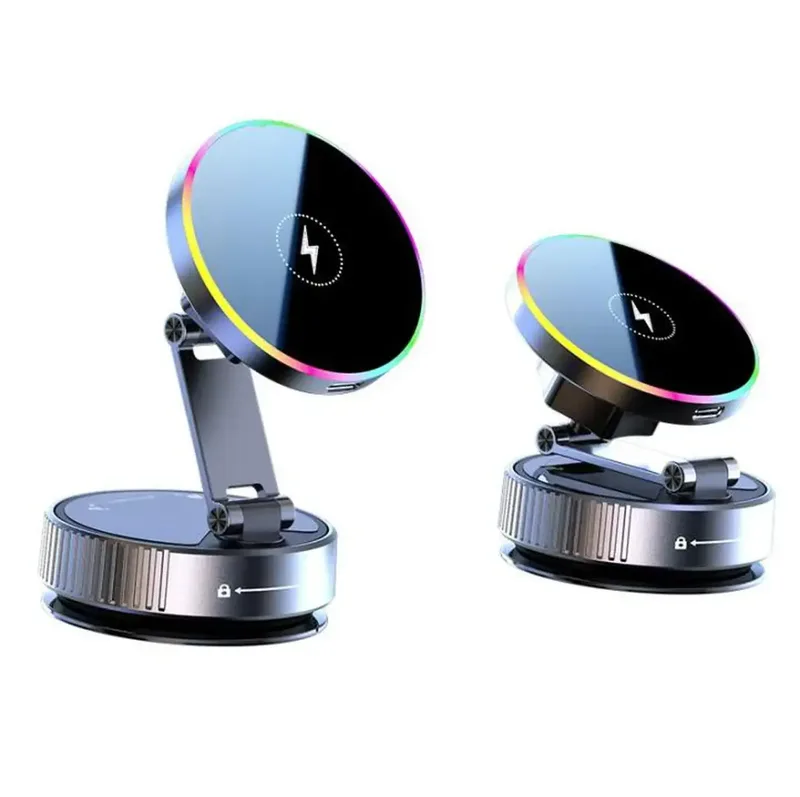
Key takeaways
Test five things before bulk: dynamic hold force, clamp mechanism life, thermal throttling at 70°C, base adhesion on three surface types, and a 1.2 m packaging drop. Ninety minutes and under $100 of tools eliminates most returns.
- Ask for samples from the production line, not “golden samples” the factory hand-builds.
- Dynamic hold matters more than static: shake the mount with a 6.7-inch phone and case, not a bare one.
- Heat is the silent killer — 20 minutes at 70°C reveals throttling, adhesive creep and plastic softening at once.
- Convert the results into PO clauses: pass criteria, AQL 2.5 inspection and a re-sample trigger.
Keywords: test car phone mount before bulk order · car mount quality control · pre shipment inspection aql · sample testing checklist · hold force test
Every factory sample passes the ten-minute test: it holds the phone, the arms open,
the light comes on. The failures that cost you money appear later — the clamp that creeps on a bumpy
road, the suction cup that lets go on a textured dashboard at 60°C, the wireless charger that stops
after twenty minutes in the sun. None of them require a laboratory to catch. They require
90 minutes, six cheap tools and a written pass criterion. This is the protocol we
recommend to buyers placing a first bulk order.
What you can and cannot learn from a sample
| Property | Test | Time | Pass criterion (typical) |
|---|
| Dynamic hold force | Luggage scale + shake test with a 6.7" phone in a case | 15 min | ≥800 g static; no slip over 200 shakes |
| Clamp mechanism life | 500 open/close cycles | 20 min | No skipping, no arm creep, noise stable |
| Thermal behaviour | 20 min at 70°C ambient while charging | 25 min | Graceful throttle, no shutdown, no odour |
| Base adhesion | Suction/adhesive on smooth, textured and leather surfaces | 15 min | Holds 24 h on smooth; documented limits elsewhere |
| Finish durability | 50 alcohol wipes + 24 h UV/heat exposure | 15 min + wait | No yellowing, no gloss change, no cracking |
| Transit survival | 1.2 m drop, six faces, retail carton | 5 min | No functional damage, packaging intact |
What a bench test cannot tell you: long-term wear beyond the cycles you run, and how the product
behaves in a market you have never visited. Those come from a small pilot order and customer
feedback — which is exactly why MOQs of 50–100 pcs exist.
Set up the bench: six tools, under $100
- Luggage scale (0–50 kg, 10 g resolution) — hold force and clamp grip.
- Infrared thermometer — surface temperature of the phone back and the mount
housing.
- Heat gun or a car parked in the sun — the 70°C ambient test.
- USB power meter — actual wattage into the charger, not what the label claims.
- Stopwatch and a notebook — cycle counts and timings, written down per unit.
- A real phone in a real case — 6.7-inch, thick case, because that is what
customers use.
Test 1 — Dynamic hold force
Static pull strength is the number factories quote; dynamic hold is the number that generates
returns. Procedure:
- Mount the phone (6.7", thick case) and attach the scale to the phone’s lower edge.
- Pull slowly perpendicular to the mount surface until release. Record peak — this is the static
number.
- Re-mount, then shake the mount by hand or on a rough-road drive for 200 cycles at roughly 2–3 g.
Watch for the phone rotating or sliding down.
- Repeat with the phone off-centre by 5 mm — the position a real driver leaves it in.
Pass: static ≥800 g with a plate; no slip, rotation or drop in 200 shakes, including the
off-centre position. A mount that only holds when perfectly centred will fail in the field. Holding
force varies by magnet array and plate type across our
magnetic car phone holder range — compare like for like before you
score two SKUs against each other.
Test 2 — Mechanism life
Run 500 open/close cycles and watch for three things: gear skipping (a periodic click), arm creep
(the gap widening over cycles) and motor sound change. After cycling, repeat Test 1 — a mechanism
that has lost grip after 500 cycles will not survive 10,000. On gravity hinges, check that the hinge
still holds a heavy phone after the cycles; on spring clamps, check that the spring has not taken a
set.
Test 3 — Heat and thermal throttling
This is the single most predictive test in the category. Bring the ambient to about 70°C (heat
gun on low, or a dashboard in direct sun), mount the phone and start charging. Then watch, every two
minutes for twenty minutes:
- Wattage from the power meter — does it step down 15W → 10W → 7.5W, or cut out
entirely?
- Surface temperature of the phone back — a rise beyond roughly 12–15°C above
ambient is a warning sign.
- Physical changes — adhesive creep on pads, plastic softening, odour, discoloured
housing.
Pass: charging continues at a reduced rate with automatic recovery; no shutdown, no smell, no
deformation. Fail: stop-start behaviour, or a housing hot enough to be uncomfortable to touch. Our
wireless charging range states the throttle behaviour per
model, so you know what the sample should do before you switch the heat gun on.
Test 4 — Base adhesion on three surfaces
Take the mount to a car and test the base on: (a) smooth dashboard or glass, (b) textured or
soft-touch plastic, (c) leather or vinyl. Suction cups are designed for (a) and will fail on (b) and
(c) — the question is whether the packaging says so. A product that fails silently on leather while
the box claims “universal dashboard fit” generates returns no matter how good the mechanism is.
For adhesive pads, clean the surface with alcohol, apply, wait 24 hours and then hang the phone
overnight. Pads that creep within a day will creep in a customer’s car within a week.
Test 5 — Finish and material durability
Two cheap checks that catch most cosmetic returns:
- Alcohol wipe: 50 passes with a 70% IPA wipe on the housing and printed logo.
Print that disappears in a month reads as “fake” to a customer.
- Heat + UV: 24 hours on a dashboard or under a UV lamp. White plastics yellow,
soft-touch coatings turn tacky, and cheap chrome flakes. Record the change per unit.
Test 6 — Packaging and transit
Drop the retail carton from 1.2 m onto concrete, six faces, once each. Then open it and run Test 1
again. Breakage inside intact packaging is the worst outcome because the customer blames the product,
not the courier; a crushed box with an intact product is merely annoying. For cartons, ask for the
compression rating and stack three high for a week in a humid room if you ship by sea.
Turning results into PO clauses
| Clause | What to write |
|---|
| Acceptance criteria | The pass numbers from this protocol, per SKU, as an annex to the PO |
| Inspection standard | AQL 2.5 for major defects, 0 for critical (safety, electrical, sharp edges) |
| Sampling | Pre-shipment inspection on a random sample of the finished lot, photos and video included |
| Corrective action | Written CAPA within 5 working days for any major defect found |
| Re-sample trigger | Any change of material, motor supplier or coil vendor requires new samples |
This is also where compliance documents connect to physical testing: the certificate pack tells
you the product may be sold, the bench test tells you whether the units in the carton are the
ones that were certified. Our
certification guide covers the
paperwork side, and the MOQ guide explains how to
structure a first order so you can test without over-committing.
A realistic first-order sequence
- Week 1 — request 3–5 production samples per SKU; run this protocol; score each
unit.
- Week 2 — send failures back with conditions; request corrective action and
re-samples for failing SKUs only.
- Week 3–4 — place the PO with the pass criteria annexed; confirm certificates and
label artwork in the same document.
- Before shipment — pre-shipment inspection at AQL 2.5, with photos of the actual
cartons and a short video of the mechanism running.
Buyers who run this sequence typically report that the second order is where the margin appears —
because the SKUs that failed the bench test never made it into inventory.
Get a free sample / wholesale quote: tell us which SKUs you want to test and your
destination market on the wholesale inquiry page — samples ship in 3–5
days with the test reports, and we will run the same protocol with you on a video call.
More wholesale guides: CE, FCC, RoHS & Qi explained · 15W coil design & auto-clamping · How MOQ really works.
FAQ
How many samples should I test?
Three to five units per SKU, drawn from a production lot rather than hand-built golden samples. One unit tells you what the best case looks like; five tell you the variance — and variance is what generates returns.
Can I test without a laboratory?
Yes. A luggage scale for hold force, an infrared thermometer or heat gun for thermal tests, a USB power meter for charging, a stopwatch, a 1.2 m drop height and a car on a rough road cover every check in this protocol. Total cost is under $100, and the results correlate strongly with field failures.
What is AQL 2.5 and should I use it?
AQL (Acceptance Quality Limit) defines how many defects a lot may contain and still be accepted. 2.5 is the common consumer-goods level for major defects, with critical defects (safety, electrical short, sharp edges) at zero. Write it into the PO before production, not after the inspection finds problems.
How do I measure hold force properly?
Attach a luggage scale to the mount head, mount a 6.7-inch phone in a thick case, and pull perpendicular to the surface until it releases. Record the peak value. Then repeat while shaking the mount — the number that matters is the force at which the phone slips under vibration, not the static maximum.
What if the sample fails — should I cancel the order?
Usually not. Send the failure list with the exact conditions (temperature, cycle count, surface type) and ask for a corrective action plan plus new samples. A factory that responds with engineering detail is a better partner than one whose first sample passed by luck.
Source these products direct from the factory
Get wholesale pricing, OEM/ODM options, and samples for any model on this page.
Get Wholesale Quote →